
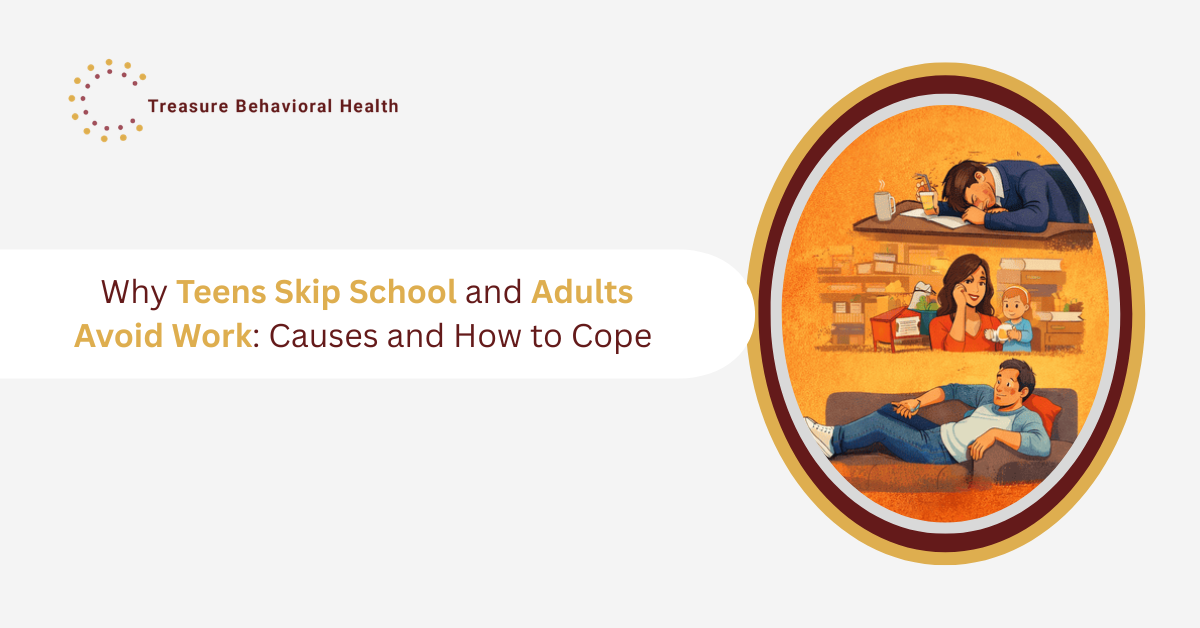
It’s a quiet Tuesday morning. Even though the alarm went off twice, your teens won’t get out of bed for school. Or you may be looking at your laptop because you don’t want to deal with another deadline at work. This happens to people from all over the world. They aren’t just being lazy; their behavior is affected by mental health issues like anxiety, depression, ADHD, or trauma.
Treasure Behavioral Health is here for people and families going through this. When you skip school or call in sick, your brain is usually trying to keep itself from getting too stressed. What’s the good news? Once you know what causes avoidance behavior, you can deal with it in a caring and practical way.
What Avoidance Really Looks Like and Why It’s Not “Just Laziness”
Avoidance can be seen in actions that are easy to get wrong.
For teens, it might look like this:
- Drawn-out morning battles
- Headaches or stomachaches that start suddenly and go away as soon as the school bus leaves
- Putting off homework until the last minute
Some common signs for adults are:
- A lot of last-minute sick calls
- Putting off important emails until they pile up
- A lot of fear at the start of the workday
The main difference between a low day and a deeper pattern is that the former occurs more often and has a greater impact. Avoiding things for a long time can hurt relationships, responsibilities, and self-esteem.
At Treasure Behavioral Health, we tell adults and families that this behavior is not a flaw in their character; it is a sign. The brain is doing its job: keeping you safe from things that seem scary or too much to handle. When you understand this, the conversation shifts from blame to care, making it easier to find answers that matter.
Behavioral Causes in Teens: Why School Can Feel Impossible
School isn’t just about classes and homework; it’s also a place where you can see, hear, touch, taste, and smell things. This can be hard to deal with if you have mental health problems.
-
Anxiety as a Hidden Driver of School Avoidance
When you’re anxious, it can feel dangerous to walk through the school doors. Social worries, performance pressure, and fears of being alone can all trigger the brain’s fight-flight-freeze response. Teens might be worried about:
- Being called on in class
- Getting along at lunch
- Taking tests they don’t think they are ready for
This can get worse in the digital world. Seeing “perfect” times on social media can make schoolwork seem like too much to handle. The body says, “Stay safe at home,” which, over time, makes worry worse.
-
Depression and the Motivation Drain
Depression slowly takes away your energy and motivation. Teenagers might feel:
- Not wanting to do things or learn things you used to like
- Having a hard time getting out of bed
- Getting tired even when doing simple things like packing a bag
Avoidance may seem like the only way to get through the day, but it’s not a sign of laziness; it’s the mind saving energy when everything seems heavy and dark.
-
ADHD and Executive Function Overwhelm
Teens with ADHD may have trouble starting chores or making changes, such as getting ready for school in the morning or transitioning from one class to another. It seems like an extra work to plan, and pay attention to anything, so avoiding them is an unintentional way to get away from being too busy.
-
Trauma, Bullying, or Sensory Overload
People who have been bullied, have been through trauma, or are sensitive to certain sounds or crowds may find school to be upsetting. Families might see:
- Suddenly getting quiet
- Groups of friends that change
- Not wanting to talk about what happened at school
The brain protects itself by pulling away like this.
-
Family and Life Transitions
Teenagers may feel unsafe when things change a lot, like moving, stress from their parents, or problems with their siblings. School can be unpredictable, and skipping it can help you regain control.
Related: Behavioral Problems in Teens: When to Seek Help
The Adult Mirror: Why Work Becomes Something to Dodge
Adults have the same problems, but they happen in different places:
-
Workplace Anxiety and Performance Fear
Fear of making mistakes, getting harsh feedback, or being judged can make people avoid things, just as school anxiety can.
-
Depression’s Quiet Erosion of Drive
Depression makes you less energetic and less focused. You might think that the only way to deal with it is to call in sick or put things off.
-
ADHD in Adulthood
ADHD that goes undiagnosed or untreated lasts into adulthood. Adults have trouble with:
- Deadlines that were not met
- Not responding to emails
- Not wanting to do work tasks
-
Trauma, Burnout, or Life Stress
It might be harder to avoid things when you work from home because the lines are less clear. When you’re stressed, anxious, or tired, it can feel like you should put off your responsibilities forever.
Shared Behavioral Patterns Across Ages
“Avoidance Loops” are patterns that teens and adults repeat.
- Overwhelm response: The brain stops working when things get too complicated.
- Looking for safety: Picking the safety of home over possible dangers
- No motivation: When you don’t have enough energy, it seems like you can’t do anything.
You can see these patterns in:
- Anxiety disorders: Withdrawal caused by fear
- Depression: Staying away from things that make you feel tired
- ADHD: Issues with executive function
- PTSD: Things in the environment that set it off
- If you have bipolar disorder, OCD, or schizophrenia, withdrawal symptoms will be worse.
Unaddressed avoidance in the teen years often leads to problems at work as an adult. This shows how important it is to get help early.
The Vicious Cycle: How Avoidance Strengthens Itself
Avoidance seems like a good idea at first, but it gets worse:
- A situation makes you feel uneasy (like school, work, or a meeting).
- Avoidance gives quick relief.
- The brain learns that “avoidance = safety,” which makes it easier to avoid things in the future.
- You lose confidence, miss chances, and the pain gets worse.
You don’t have to force action to break the pattern. Instead, you need to address the root issue and take small steps forward.
Practical Coping Strategies That Break the Pattern
- 5-Minute Launch Sequence: Sit up, put your feet on the floor, take three deep breaths, drink water, and then do one small thing.
- Sensory Grounding: Name five things you see, four things you touch, and three things you hear.
- Small Commitments based on Values: Focus on one small thing at a time. Kids should focus on one step at a time, like the first period, and adults should focus on the first email.
- Soft Movement: A short walk, some stretching, or dancing to music.
- Visual Cues: Lists or reminders on your phone that are easy to understand.
Family and Self-Support Tools for Teens
- Say things like “I notice.”
- Work together on small tests, like shorter school attendance or using virtual choices.
- Slowly exposing yourself builds confidence
Workplace-Friendly Coping for Adults
- Learn when you have the most energy and protect your focus windows.
- Be sure that everyone knows the rules and stays within boundaries, especially when they are working from home.
- Divide work into small, manageable steps.
Pattern Interrupt Toolkit
- Body reset: Moving or breathing to calm down the nervous system
- Change your mind: Instead of saying “I can’t do this,” say “This is hard, but I can take one small step.”
- Connection bridge: Talk to a therapist or someone you trust.
These methods work well with CBT, mindfulness, and techniques that are specific to ADHD.
When to Seek Professional Mental Health Support
Reach out when avoidance:
- Lasts a long time
- Gets in the way of relationships or life
- Changes how you see yourself
- Makes physical problems worse or makes people feel alone
We offer the following at Treasure Behavioral Health:
- Therapy that is made just for you
- Medication management, if you need it
- Behavioral coaching that looks at the root problems, like anxiety, depression, ADHD, and trauma
- Provide care for people 16 and older
Conclusion
Avoidance is comprehensible, amenable to treatment, and modifiable. To make real change, you need to know where your behavior and mental health problems come from. With professional help, small, steady steps can break the cycle and help you feel more confident and connected.
You don’t have to accomplish this by yourself. Treasure Behavioral Health helps teens and adults break free from patterns of avoidance and regain focus, motivation, and independence.
Make an appointment for a consultation today and start making lasting changes.
FAQs
Is skipping school the same as not going to work?
Yes, they share a common foundation in behavior and mental health.
Does having ADHD really make adults not want to work?
Yes, for sure. Problems with executive function can last into adulthood.
How can I talk to my teen about skipping school without getting into a fight?
“I’ve noticed that mornings are hard.” Start by being curious. “Can we talk about why?”
Does improving sleep help?
Most of the time. Better sleep improves your mood, focus, and energy, which makes you less likely to put things off.
No comment